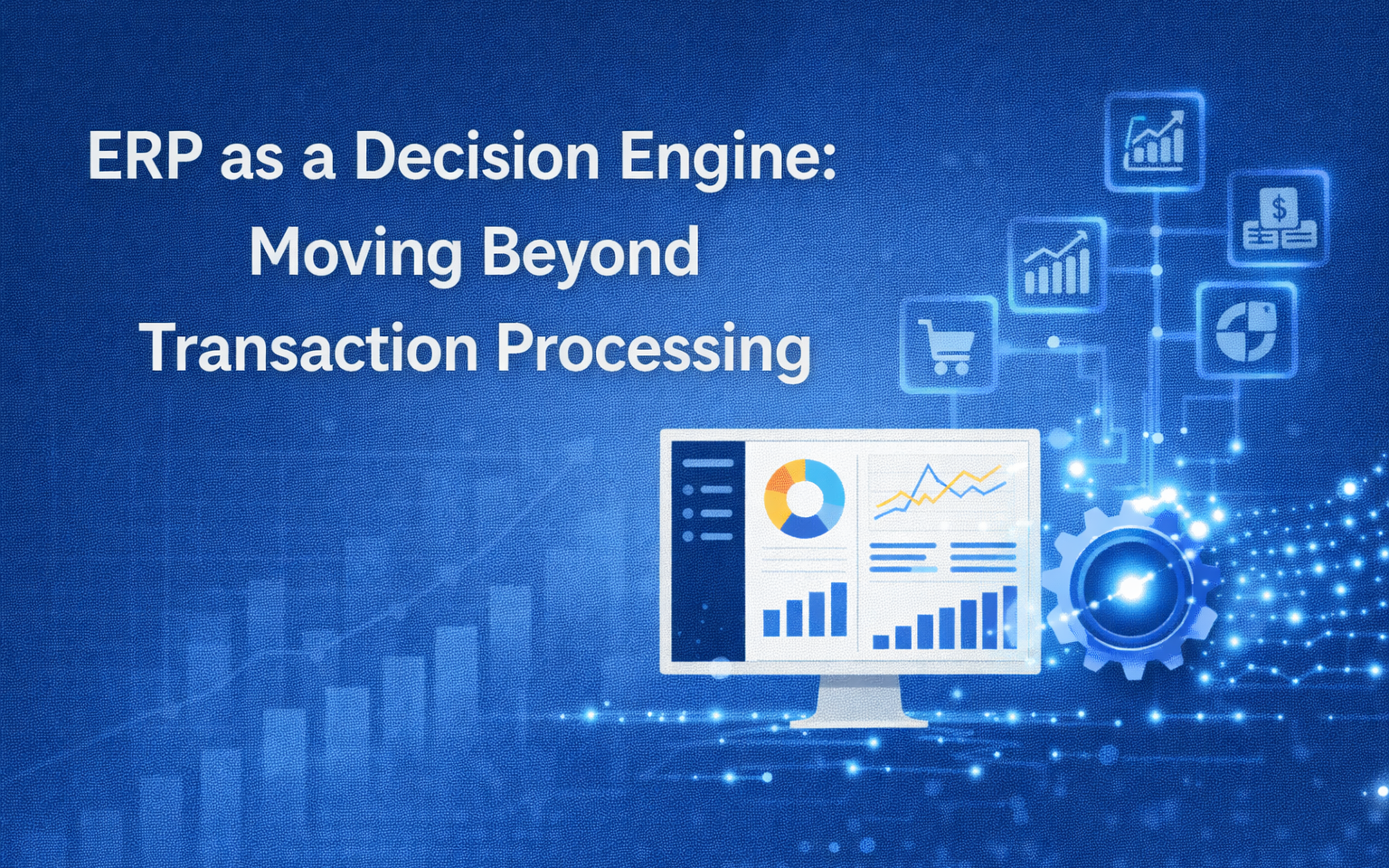
ERP as a Decision Engine Moving Beyond Transaction Processing
For many organizations, ERP systems are still viewed as transaction tools — used mainly for posting invoices, recording entries, and closing books.
But in today’s digital business environment, ERP must do far more than process transactions.
It must become a decision engine — enabling leaders to act faster, smarter, and with greater confidence.
The Limitation of Transaction-Focused ERP
Traditional ERP usage focuses on:
- Recording what already happened
- Storing historical data
- Supporting compliance and control
While important, this approach leaves a critical gap:
ERP captures data but does not actively support decisions.
As businesses grow more complex, this limitation slows response time and reduces strategic agility.
The Shift: From System of Record to System of Intelligence
A modern ERP environment evolves from:
System of Record → System of Insight → System of Decision
This shift transforms ERP into a platform that not only stores data but also interprets, analyzes, and guides action.
How ERP Becomes a Decision Engine
- Real-Time Data Visibility
Modern ERP dashboards provide live insights into:
- Financial performance
- Cash flow and liquidity
- Inventory and supply chain status
- Sales and demand trends
When data is visible in real time, leaders no longer wait for reports — they act immediately.
- Integrated Business View
ERP becomes powerful when connected with:
- CRM and sales systems
- Banking and payment platforms
- Warehouse and logistics systems
- Analytics and BI tools
This integration creates a single source of truth, eliminating conflicting numbers and improving decision confidence.
- Insight-Driven Dashboards
Instead of static reports, ERP decision engines deliver:
- KPI-focused dashboards
- Variance explanations
- Trend analysis
- Early-warning indicators
The focus shifts from “what happened” to “what should we do next?”
- Predictive and Scenario-Based Planning
When ERP data is combined with analytics, organizations can:
- Forecast revenue and cash flow
- Simulate demand changes
- Evaluate cost scenarios
- Anticipate risks before they occur
ERP becomes a forward-looking tool — not just a historical ledger.
- Embedded Automation for Action
A true decision engine doesn’t stop at insight — it enables action.
Examples include:
- Automated alerts for threshold breaches
- Workflow triggers based on KPIs
- Auto-approvals or escalations
- Exception-based management
This shortens the distance between insight and execution.
Why This Matters for Leadership
When ERP functions as a decision engine:
✔ Decisions are faster
✔ Risk is detected earlier
✔ Performance gaps are visible instantly
✔ Teams operate with clarity and alignment
Finance, operations, and leadership move from reactive management to proactive control.
How Hilniva Enables ERP-Driven Decision Intelligence
At Hilniva, we help organizations transform ERP from a transaction system into a decision-enabling platform through:
- ERP optimization and integration
- Real-time dashboards and analytics
- Automated workflows and alerts
- Finance and operational intelligence
Our approach ensures ERP delivers business outcomes — not just system outputs.
Final Thought
ERP should not be limited to recording the past.
Its true value lies in shaping the future.
Organizations that move beyond transaction processing and use ERP as a decision engine gain agility, confidence, and competitive advantage.
Connect with us to explore more
Hashtags
#ERP #DecisionIntelligence #DigitalTransformation #BusinessIntelligence #ERPAnalytics #Automation #DataDrivenDecisions #Hilniva #EnterpriseTechnology #Leadership