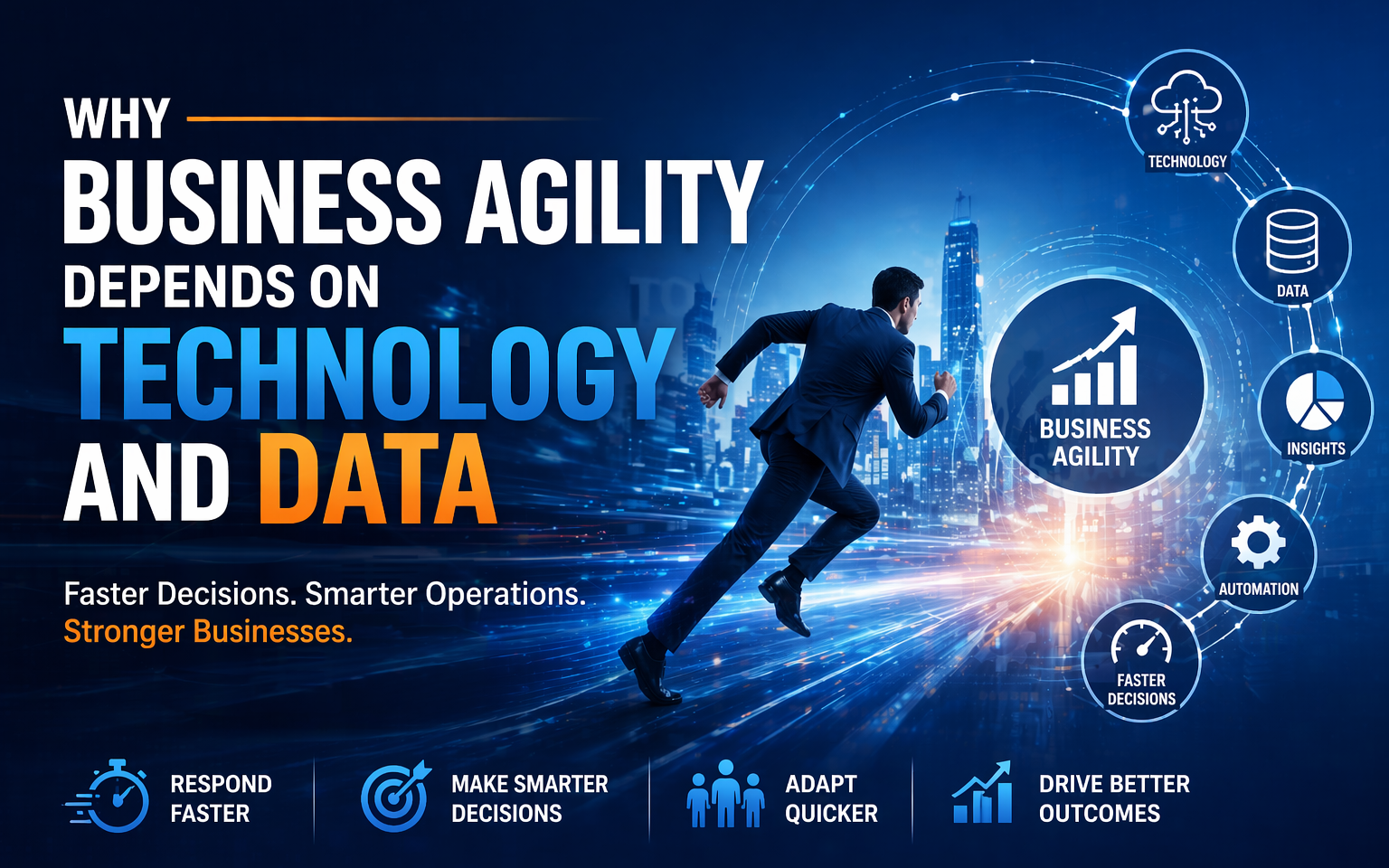
Why Business Agility Depends on Technology and Data
In today’s fast-changing business environment, agility is no longer a competitive advantage .it is a necessity.
Organizations must respond quickly to shifting customer demands, market dynamics, and operational challenges.
The ability to adapt, decide, and act faster than competitors defines success.
At the core of this agility are two critical enablers:
Technology and data.
What Is Business Agility?
Business agility is the ability to:
- Respond quickly to change
- Make timely and informed decisions
- Adapt processes and strategies
- Scale operations efficiently
Agile organizations are not just reactive — they are proactive and responsive.
Why Many Organizations Struggle with Agility
Despite having data and systems, many businesses face:
- Delayed reporting cycles
- Fragmented data across systems
- Manual processes slowing execution
- Lack of real-time visibility
- Slow decision-making
These challenges create operational friction, making it difficult to respond quickly.
Technology Enables Speed and Flexibility
Modern technology platforms such as ERP systems, automation tools, and analytics solutions provide the infrastructure for agility.
They enable:
✔ Real-time data access
✔ Automated workflows
✔ Integrated business processes
✔ Faster execution across departments
Technology removes delays and allows organizations to operate at speed.
Data Enables Smarter Decisions
Speed alone is not enough — decisions must also be accurate.
Data provides:
- Real-time insights into performance
- Visibility into risks and opportunities
- Clarity on financial and operational metrics
With data-driven insights, leaders can make confident decisions quickly.
The Power of Integration
Agility requires alignment across functions.
When systems are integrated:
- Finance, operations, sales, and supply chain share the same data
- Decisions are based on a unified view
- Teams collaborate more effectively
Integration ensures that the organization moves as a connected system, not isolated departments.
From Reactive to Proactive Organizations
Technology and data enable organizations to shift from:
- Reactive problem-solving → Proactive planning
- Delayed reporting → Real-time visibility
- Manual processes → Automated workflows
- Assumption-based decisions → Data-driven decisions
This transformation is what defines true business agility.
Building an Agile Organization
To become agile, organizations must:
✔ Invest in integrated technology platforms
✔ Automate key business processes
✔ Enable real-time data visibility
✔ Build a data-driven culture
✔ Align strategy with execution
Agility is not achieved through speed alone — it is built through structure, visibility, and intelligence.
How Hilniva Enables Business Agility
At Hilniva, we help organizations become more agile by enabling:
- ERP-driven integration
- Intelligent automation
- Real-time dashboards and analytics
- Data-driven decision frameworks
Our solutions empower businesses to adapt quickly, operate efficiently, and respond confidently to change.
Final Thought
Agility is not about reacting faster —
it’s about being prepared to act at the right moment with the right insight.
Technology provides the speed.
Data provides the direction.
Together, they enable organizations to move with clarity, confidence, and control.
Connect with us to explore more.
#BusinessAgility #DigitalTransformation #DataDriven #ERP #Automation #BusinessStrategy #Innovation #Hilniva #OperationalExcellence #Leadership